Best Languages for Balkan Hospitality Menus: A Practical Priority Guide
Once a property decides to go multilingual — covered in our Montenegro and Kosovo QR menu guide — the next question is almost always the same: which languages first? Translating into every guest nationality at once is rarely the right move for a small or mid-sized property. Here is a practical order.
1. Start With Your Booking Data, Not Assumptions
Before translating anything, pull the last 12 months of bookings by guest nationality from your PMS or booking platform. Region-wide tourism statistics are a reasonable starting point, but they smooth over real differences between a beach-facing property in Budva and a heritage guesthouse in Kotor's old town — the two can have almost opposite guest mixes despite being a few kilometers apart.
2. The Core Five for the Adriatic Coast
For most coastal Montenegrin properties, five languages cover the large majority of guests: Montenegrin/Serbian (regional travelers), English (the practical default for everyone else), German, Russian, and Albanian. This order is not fixed — a property near Tivat's marina with a strong yacht-charter clientele may see English and Italian dominate, while a Petrovac apartment-hotel popular with regional bus tours may need Serbian and Russian first.
3. When to Add Italian, French, or Polish
These three show up consistently as the "next tier" across the coast, driven by cruise ship stops, charter yacht tourism, and a growing Polish package-tour presence in recent seasons. They are usually worth adding once the core five are live and you have a season of scan data showing which secondary languages guests actually select on the menu itself — most QR menu platforms log this automatically.
4. Kosovo's Different Mix
Kosovo's hospitality market does not mirror the coast. Albanian and English form the practical base for almost any property, in Prishtina or around the Brezovica ski area. German follows closely given the size of the Kosovar diaspora returning seasonally from Germany, Switzerland, and Austria, with Turkish as a strong fourth in many urban properties. Russian, by contrast, is rarely worth prioritizing in Kosovo the way it is on the Montenegrin coast.
5. Machine Translation vs Native Review
Machine translation is good enough for a first pass on most menu line items, but two areas consistently need a native speaker's eye: allergen and dietary terminology, where a wrong word is a safety issue rather than a style one, and local dish names, where a literal translation can strip out the context a guest needs (a "kačamak" or "burek" translated word-for-word means nothing to a German guest without a short descriptive clause). A native review pass for these two categories, even if the rest stays machine-translated, covers most of the real risk.
6. Rolling Out Without Overwhelming Staff
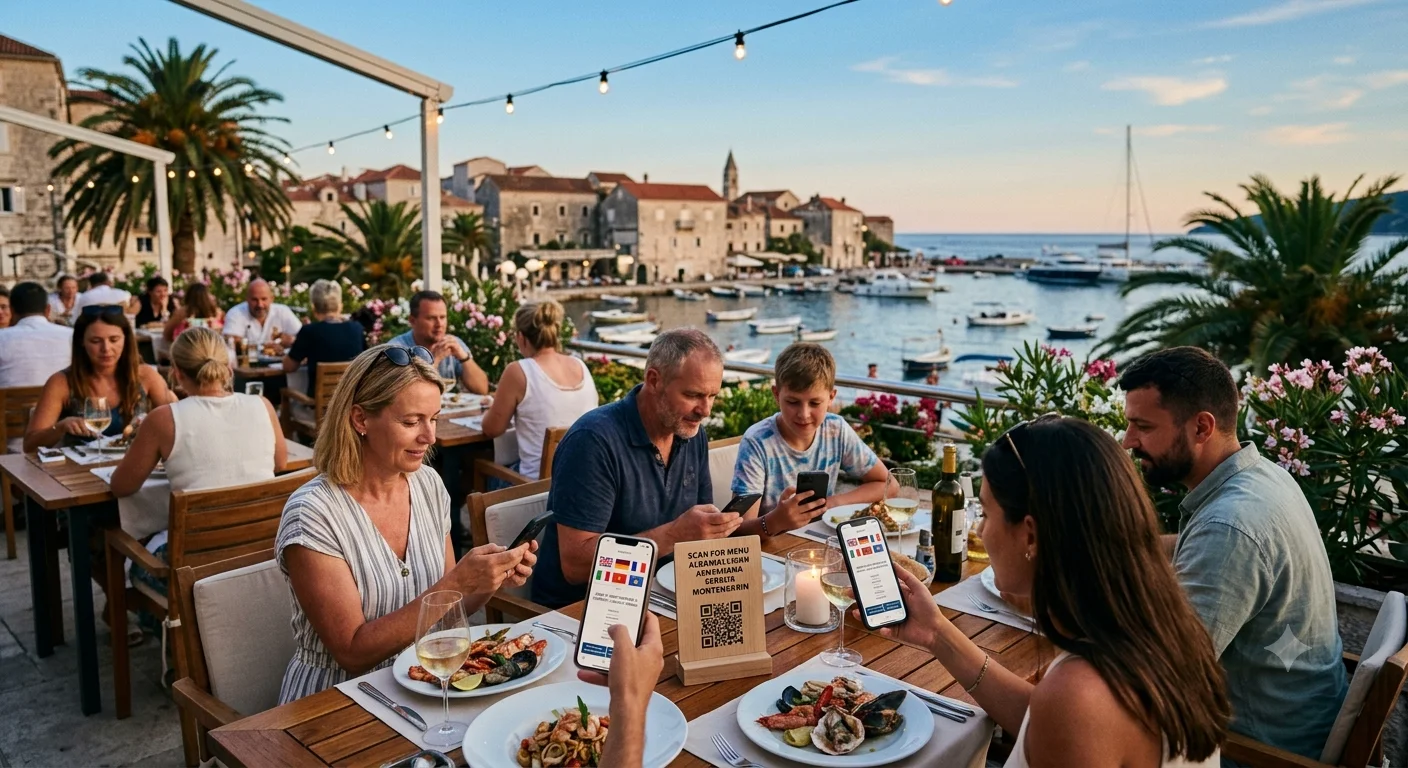
Add one language at a time rather than launching five simultaneously. Front-of-house staff need to know the menu is multilingual and roughly what it covers — even a one-line mention at check-in ("the menu also works in German and Russian, just scan again") meaningfully increases language switching versus guests discovering it on their own. Properties using a QR menu system can usually update available languages from the dashboard without any reprint, which is what makes a staged rollout practical in the first place — see our guide on eliminating reprint costs with real-time updates.
Conclusion
Language priority for a Balkan hospitality menu should follow your actual booking data, not a generic regional assumption — a coastal Montenegrin property and a Kosovar mountain lodge can have almost no overlap in priority languages despite being in the same country-level statistics. Start with two or three languages backed by real numbers, review allergen and local-dish terminology with a native speaker, and expand based on what guests actually select.